
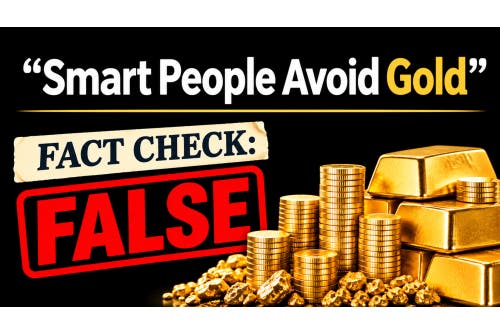
Warren Buffett has long argued that gold is an unproductive asset. Unlike stocks, businesses, or real estate, it doesn't generate earnings, produce income, or create goods and services that drive the economy.
For investors with decades to compound wealth, he may have a point.
But retirement investing is a different challenge entirely.
As we move into an era defined by rapid technological change, high government debt, geopolitical tensions, and market uncertainty, many investors are viewing gold less as a growth asset and more as a financial safety valve: something that can hold value, provide liquidity, and help offset risk when stocks struggle.
That's why large investors continue to embrace it.
Former hedge fund manager Ray Dalio has repeatedly suggested investors hold 10% to 15%[1] of their portfolios in gold as a hedge against debt, inflation, and broader economic risks.
He's far from alone.
"Gold is an asset we see as cheap, a good hedge and sufficiently liquid," Lorenzo Portelli, head of cross-asset strategy at Amundi Investment Institute, said earlier this year[2].
That last word, liquid, is especially important for retirees.
This isn't an argument about where gold prices will be next month or even next year. It's about how investors can prepare for a scenario that becomes much more important once they start living off their portfolios.
And the conditions for that scenario already exist:
- U.S. stocks remain expensive by historical standards.
- Millions of Baby Boomers are entering or already in retirement.
- Bonds no longer provide the same level of protection many investors once expected.
- Government debt and deficits continue to grow around the world.
- Affordability and cost-of-living pressures remain a concern for many households.
That means the biggest threat for many retirees isn't necessarily a recession, inflation spike, or bear market by itself.
It's a sequence-of-returns risk event.
That occurs when a severe market decline hits early in retirement, forcing investors to sell assets at depressed prices to fund everyday living expenses. Even if markets eventually recover, selling during the downturn can permanently damage a portfolio's long-term value.
To see why, consider two retirees.
Retiree A: Stocks Only
Retiree A is 66 years old and has accumulated a $1 million retirement portfolio invested entirely in stocks. He plans to withdrawal $50,000 annually to supplement other retirement income.
Then a major bear market arrives.
Whether it's triggered by an economic slowdown, a valuation reset in technology stocks, or some other shock doesn't really matter. His portfolio falls 35%, reducing its value to $650,000.
The problem isn't just the decline itself.
Retiree A still must pay housing costs, buy groceries, and cover transportation expenses. To generate income, he must continue selling stocks even though prices are sharply lower. Suppose the bear market lasts long enough that he withdraws $100,000 over two years. His portfolio falls to roughly $550,000.
Now the mathematics become difficult.
A portfolio that drops from $1 million to $550,000 requires an 82% gain just to return to its starting value. Even if markets eventually recover, years of withdrawals during the downturn make it much harder to rebuild wealth.
This is the essence of sequence-of-returns risk. The losses aren't just temporary. They can permanently reduce the portfolio's future earning power because shares sold during the downturn can never participate in the rebound.
Retiree B: Stocks Plust Gold
Retiree B is also 66 years old with a $1 million portfolio.
The difference is that he followed Dalio's suggestion and allocated 15% to gold.
His portfolio consists of:
- $850,000 in stocks
- $150,000 in gold
When stocks decline 35%, the stock portion falls to roughly $552,000.
If gold simply holds its value, his total portfolio stands at about $702,000. That may not seem dramatically different from Retiree A's situation at first glance.
But the source of retirement income is different.
Instead of selling beaten-down stocks, Retiree B can use part of his gold allocation to fund living expenses. Doing so gives the stock portion of his portfolio more time to recover without additional shares being sold near market lows.
In effect, gold becomes a financial shock absorber. And history suggests it can sometimes do more than merely hold its value.
Following the dot-com collapse, gold climbed over 200% between 2001 and 2007[1]. Strong gains during the early years of that recovery helped offset weakness elsewhere in investor portfolios. There's no guarantee that history repeats itself, as gold can experience long periods of underperformance, just as stocks can.
But that's not really the point.
The goal isn't for gold to outperform stocks over the long run. The goal is to own an asset that may provide liquidity when investors least want to sell stocks and can potentially rise in value during periods when traditional financial assets are under pressure.
Gold's Real Job in Retirement
Gold doesn't need to beat stocks to deserve a place in a retirement portfolio.
For retirees, its greatest value may be its ability to serve as a reserve source of cash during difficult markets. By providing a potential funding source when stocks are down sharply, gold can help reduce the risk of selling long-term investments at exactly the wrong time.
In other words, gold's role isn't necessarily to make you richer.
It may simply help protect you from making costly decisions when stocks are performing at their worst.
Posting in:
 byUnited States Gold Bureau