

Ueno Bank Turned Your Balance Into a Barrier
Paraguayan bank, Ueno, didn’t need a cyberattack to lock people out of their money. All it needed was its own bad loans, weak capital, and a regulator willing to shut the doors. Nearly 3 million customers were frozen out of access to their accounts. Roughly $800 million in public deposits sat inside the bank. Then the app, cards, transfers, and branches went completely dark.
Paraguay Lost Access First but The Account Was Left Sitting There
Ueno grew from an obscure finance company into a household name in less than five years. It claimed more than 60% of Paraguay’s adults as customers. The bank also held public money, including funds tied to the state pension and health system and the country’s hydroelectric dams. Then regulators found poorly documented loans, lending to insiders, and expenses counted as assets. Once the books were corrected, Ueno’s capital fell below half the legal minimum. Paraguay’s central bank seized the lender and began moving customers and assets to other institutions. The damage wasn’t theoretical. Ueno’s app, cards, and transfers went dark. Branches locked their doors. Authorities began opening accounts elsewhere for about 280,000 people who banked only with Ueno. A bank account isn’t money in your hand. It’s a claim on an institution that must remain solvent, open, and connected.
Bank Destabilization Is Ramping Up. FDIC Counted 6 Failures This Year.
The United States isn’t Paraguay. Six U.S. bank failures don’t prove a systemic panic. That’s the strongest counterargument, and it’s correct. But six failures in 2026 is still three times the two recorded in 2025. The 2026 failure list runs from Metropolitan Capital Bank & Trust in January to Nano Banc in September. That isn’t a prediction. It’s a pattern worth respecting. Bank destabilization rarely arrives with a siren. It starts as a balance-sheet problem that customers notice only after the doors close. Failure counts can sit near zero for years, then arrive in clusters. No one can promise a straight line higher. But the first failure is always somebody else’s problem. The next one makes the balance sheet personal. The crisis isn’t only whether a bank fails. It’s whether customers can still reach the money they thought they owned.
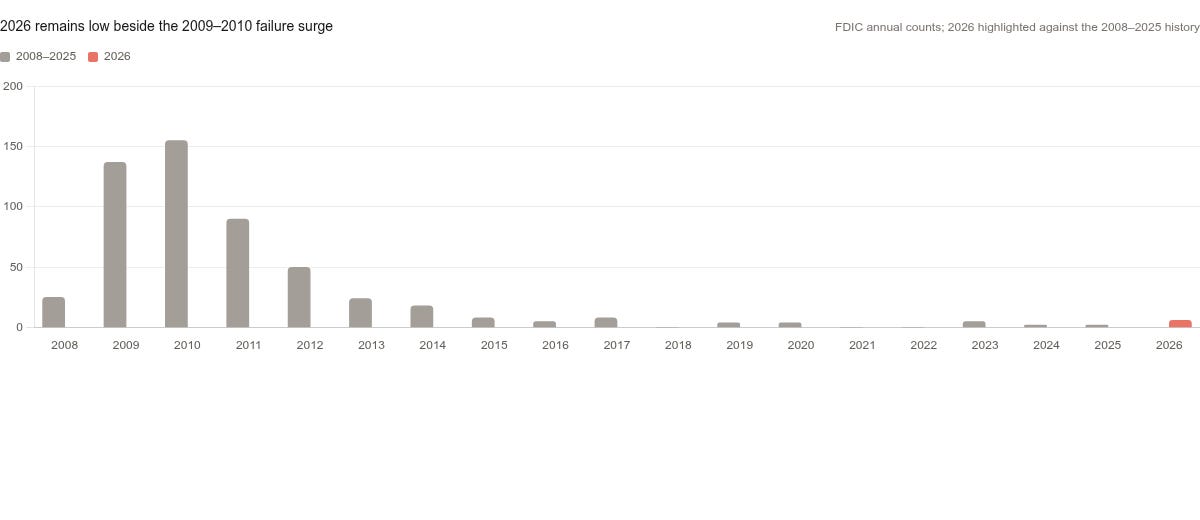
Figure 1. Six failures are nowhere near the 2009–2010 surge. But is 2026 the canary in the coal mine?
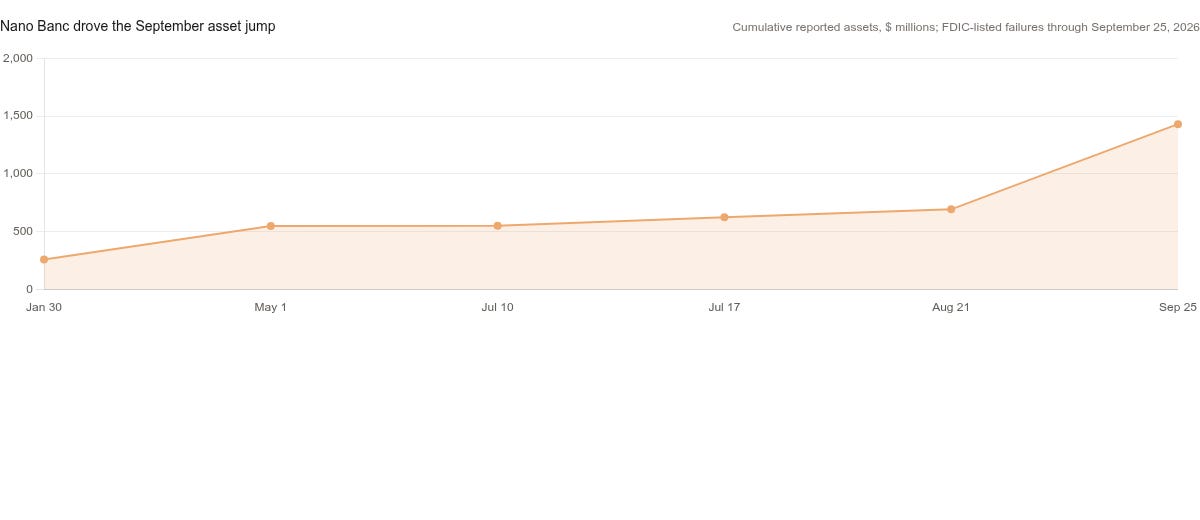
Figure 2. Cumulative reported assets jumped to $1.43 billion by September 25, 2026, after Nano Banc added $736 million.
How to read the visuals
The historical bars put 2026 in context: six failures are higher than the recent zero-failure years, but far below the 2009–2010 crisis surge. That gap frames the question under Figure 1: is 2026 the canary in the coal mine, or only a small uptick? The asset-exposure line shows why count alone is incomplete. Reported exposure jumped sharply in September when Nano Banc added $736 million to the cumulative total.
Central Banks Bought 312 Tons Before the Next Shock.
A review of World Gold Council data reported 289 tons of net official-sector gold purchases in Q2 2026 and another 23 tons in July. That adds to 312 tons through July. So a new banking shock wouldn’t create gold demand from zero. It would hit a market where reserve managers are already buying. The same review reported that 45% of central-bank respondents expected to increase their own gold holdings over the next 12 months, while 89% expected global central-bank holdings to rise.
Russia Saw $300 Billion Frozen. Reserve Managers Took Notice.
Russia showed the same danger but from a different angle. In 2022, about $300 billion in Russian central-bank assets were immobilized. The move became a clear test of how financial claims depend on jurisdiction, permission, and a functioning intermediary. The dollar didn’t become worthless. The event showed something more precise: a financial asset can be real on paper and unreachable in practice. Gold doesn’t remove every risk. Storage matters. Location matters. Price moves. But physical gold isn’t somebody else’s promise to pay. It doesn’t need an app, a branch, or a bank executive to remain solvent before ownership exists.
Own What Lasts, Before You Get Locked Out.
Gold doesn’t need an app, a branch, or a bank executive to stay solvent before ownership exists. It can sit in a vault you control, or somewhere in your house, ready when a digital balance isn’t. Keep a bank for payments. Don’t confuse a payment rail with a reserve asset. Russia showed what happens when financial assets become unreachable. Paraguay put the same lesson on a customer’s phone. Official-sector buyers already took 312 tons through July, but a visible bank failure gives reserve managers another reason to keep adding. They may not only continue buying. They may ramp it up. If banking stress spreads, the next buyers won’t start from zero. They’ll join a market where central banks and private investors are already bidding for the same metal. That can push demand, and price, higher in the coming months. Own the ounces before the crowd shows up. Don’t let other countries do it for you.
Posting in:
 byUnited States Gold Bureau