
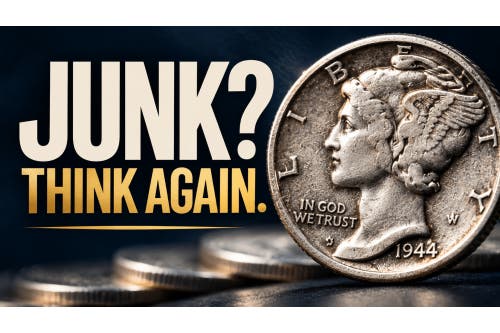
A silver dime, a Silver Eagle, and a 10-ounce bar may look very different, but they all have one thing in common: their melt value. Learn the simple formula experienced silver stackers use to judge every silver purchase.
Investors call it "stacking silver," and it's as much a mindset as a strategy.
Many stackers prefer silver to gold for three reasons:
1. Silver is affordable. At roughly $45 an ounce, silver can be accumulated gradually over time. Gold, by comparison, costs nearly $4,000 an ounce, making each purchase a much larger commitment.
2. Silver is divisible. A dime may contain just a few dollars' worth of silver, while a quarter could contain about $8. If silver were ever used for small transactions, these coins offer practical denominations. A one-ounce gold coin, worth thousands of dollars, does not.
3. Silver appears inexpensive. Not only is it well below its early-2026 peak, but measures such as the gold-to-silver ratio suggest silver remains relatively cheap compared with gold.
To succeed as a silver stacker, there is one number worth knowing: melt value.
Put simply:
Melt Value = Silver Content × Spot Price
If a coin contains 0.5 troy ounces of silver and silver trades at $50 per troy ounce, its melt value is $25.
Melt value serves as a reference point. It helps you evaluate purchases, compare different forms of silver, and track the value of your holdings over time. Regardless of what a dealer charges or what a collector is willing to pay, melt value tells you what the metal itself is worth.
This concept becomes especially important when dealing with a silver-stacker favorite: junk silver.
What's in a Name?
Despite the name, junk silver is not junk at all. The term is widely used in the coin trade to describe older U.S. coins purchased primarily for their precious-metal content rather than for rarity or collectible value. Many investors prefer the friendlier term "constitutional silver" because these coins circulated when U.S. money still contained significant amounts of silver.
But no matter what you call it, understanding the melt value can help in several ways.
First, it establishes a floor value. While a coin's collectible premium may rise or fall, the silver it contains always has value. As a result, common silver coins rarely trade below their melt value for long.
Second, it separates metal value from dealer premiums. Every silver purchase includes two components: the value of the silver itself and the markup charged by the dealer. Melt value allows you to see exactly how much of your purchase price is going toward the underlying metal.
Third, it provides a common benchmark. A Morgan silver dollar, a Silver Eagle, an old quarter, and a 10-ounce silver bar may all attract different levels of demand, but melt value lets you compare them on equal footing. At the end of the day, they are simply different ways of owning silver.
Melt value is also useful when it comes time to sell.
Dealers generally buy non-collectible silver below melt value because they need room for their own profit margin. A common range for circulated 90% silver coins is roughly 90% to 95% of melt value, depending on market conditions and demand. Understanding this distinction helps investors set realistic expectations. Melt value represents the value of the metal, while the amount a dealer pays reflects that value minus a spread.
Pay Attention to These Coins
This is not a complete list, but I wanted to share a few examples. Older Barber quarters and Standing Liberty quarters contain the same amount of silver as other pre-1965 U.S. quarters: 0.1808 troy ounces. Because all were struck from a 90% silver alloy and weigh the same, their melt values are essentially identical. Kennedy half dollars minted from 1965 through 1970 contain 40% silver rather than 90%, placing them in a separate category with lower silver content.
Likewise, most Morgan and Peace silver dollars can trade at premiums above melt value because of collector demand. Only heavily circulated, common-date examples tend to sell close to their metal value. Investors should also be aware that many older Canadian coins contain substantial amounts of silver and can offer another avenue for stacking.
The broader lesson is simple: silver content matters more than packaging.
Nineteen ounces of silver remains nineteen ounces whether it arrives as a pair of bars, a tube of Silver Eagles, or a bag of old quarters. The form may change. Dealer premiums may change. Collector demand may change. But melt value provides a consistent way to measure what you actually own.
For that reason, experienced stackers often focus on the metal first and the premium second. They know what each coin contains, what that silver is worth, and how much extra they are paying above melt value.
In the end, melt value is the foundation beneath every silver investment. It gives you a way to compare different products, judge whether a price is reasonable, and estimate what your holdings may be worth in the future.
Know what you own. Understand the silver content. And always keep an eye on melt value, because that's the one number nobody can argue away.
Posting in:
 byUnited States Gold Bureau