
Shadow Gold Is a Measuring Stick for Your Cash
Shadow Gold isn’t a new coin, a secret program, or a guaranteed price forecast. It’s the theoretical price gold would reach if paper money had to be tied to an asset with real physical value and scarcity. In other words, it’s the theoretical price per troy ounce if the U.S. dollar had to be backed by physical gold. For everyday investors, Shadow Gold rising while spot gold remains below its implied value may create an opportunity to add physical gold before the gap closes.
Paper Promises Meet Something You Can Hold.
Think of dollars as promises. Think of gold as the physical thing behind the promise. Shadow Gold puts a number on the gap between them. It’s not an official price but it does show that institutional investors and central banks secretly measure their wealth in only things you can hold in your hand. Feels like rules for thee and not for me on this one.
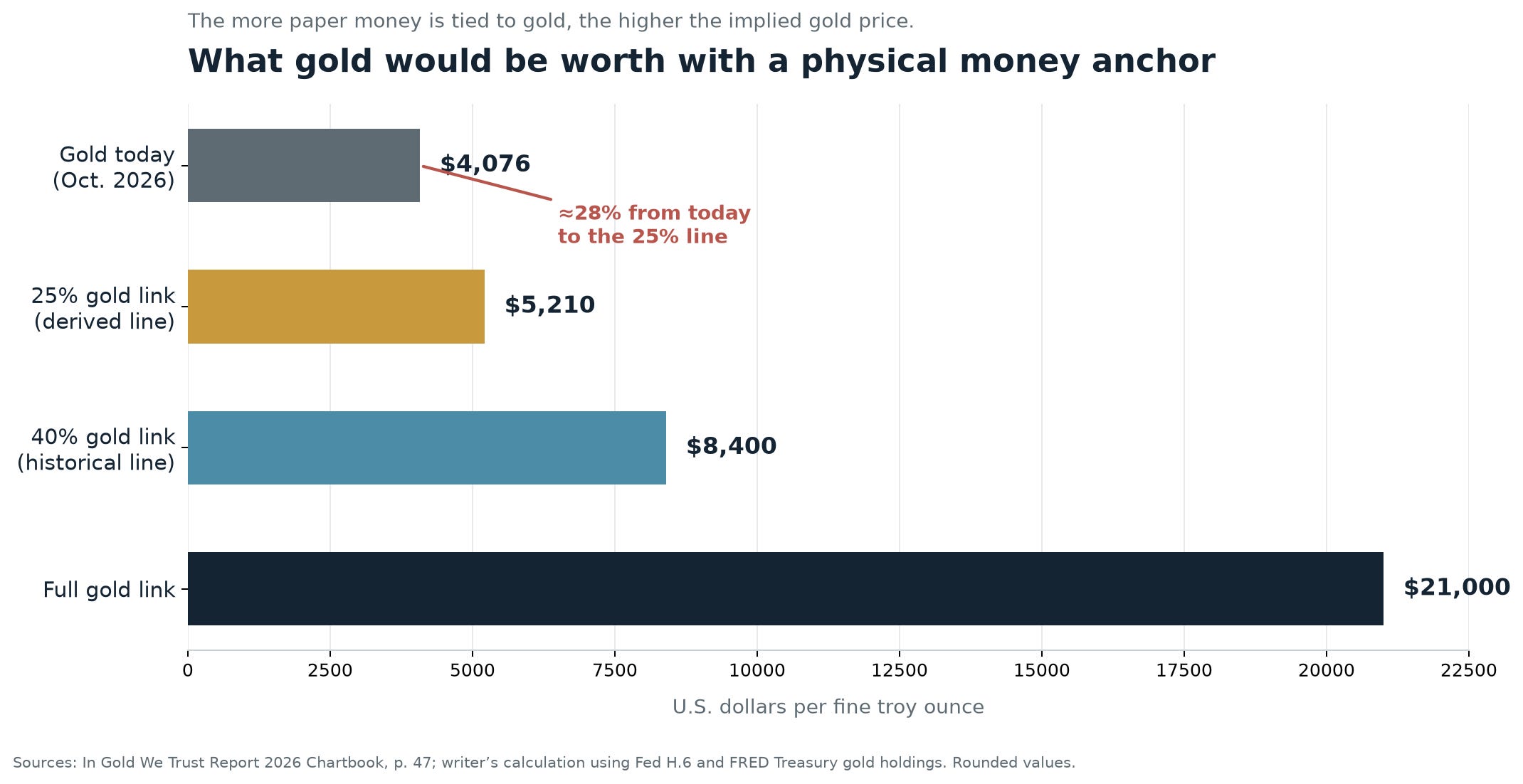
The Federal Reserve’s September 2026 H.6 release puts the monetary base at $5.4498 trillion. The monetary base is the dollars in circulation plus the reserves banks hold at the Federal Reserve. FRED lists 261,498,926 fine troy ounces of U.S. government gold for October. The government’s reported gold holdings changed little while the monetary base grew. The 25% figure comes from the historical gold-cover requirement Congress used in 1945. From December 2016 to September 2026, the base rose from $3.5316 trillion to $5.4498 trillion. At a 25% gold link, the implied price rose from roughly $3,376 to $5,210 per ounce—a 54% increase.
The math is simple: $5.4498 trillion × 25% ÷ 261.499 million ounces = about $5,210 per ounce. The chart places October 2026 spot gold at about $4,076 per ounce, leaving the 25% line roughly 28% higher.
More Dollars Change What Cash Can Buy.
Shadow Gold starts with a simple idea: paper money supply is at the whim of the federal reserve and Gold cannot be printed.
Central banks understand that. They do not publish a gold standard or promise to exchange every note for metal. But they still hold gold as their monetary anchor and solvency lever. The 2026 Chartbook shows gold at roughly a quarter of global reserves in Q2 2026, up from 9% in 2015. The message is plain: when paper promises need support, central banks still keep a physical asset nearby.
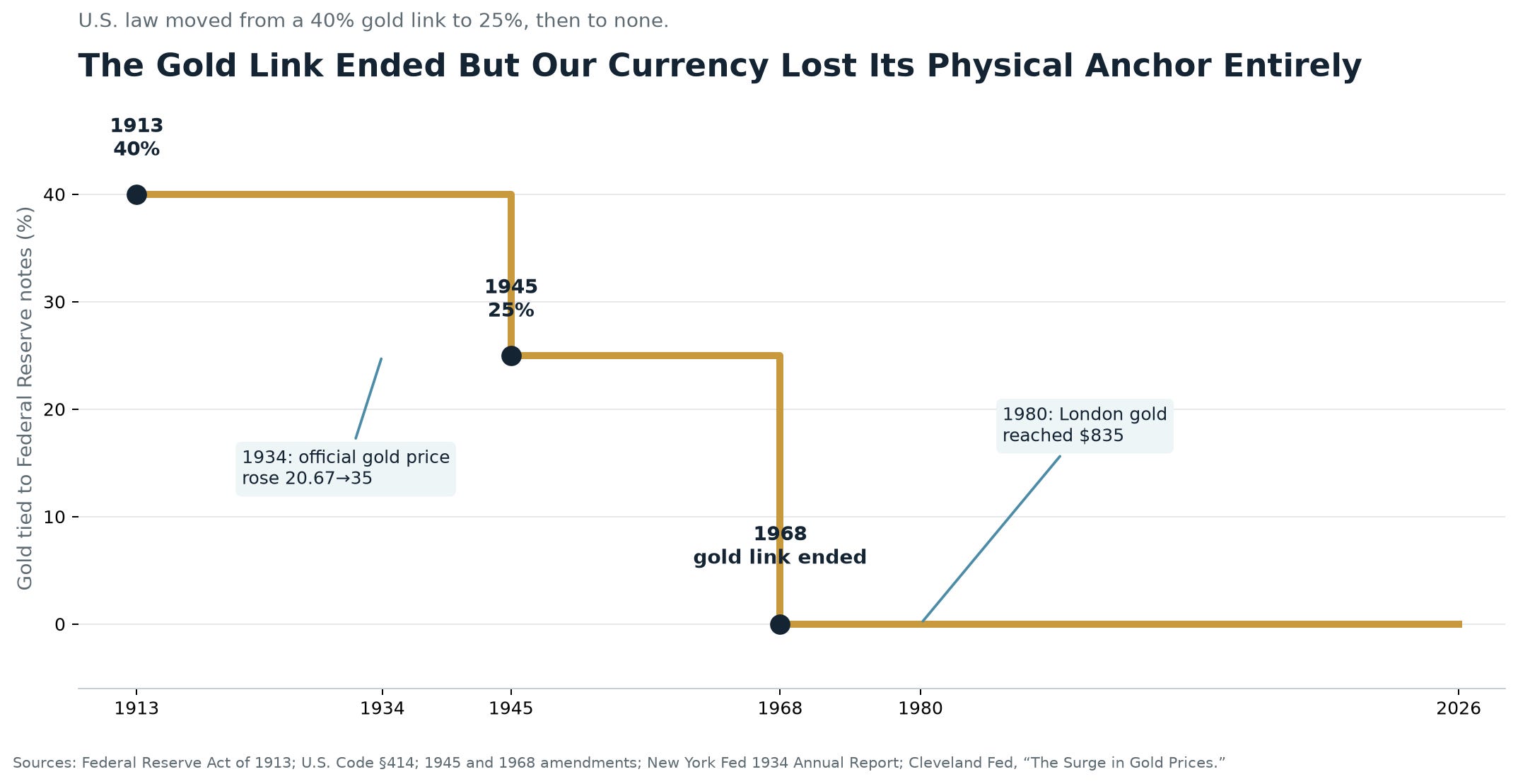
That matters to anyone who saves in cash. When more dollars enter the system, each dollar can buy less. Gold can rise because the dollar is losing value, not only because gold has changed. The 25% line is not current law. Congress reduced the old gold link from 40% to 25% in 1945, then removed the requirement in 1968. It remains useful as a simple way to measure what gold could be worth if paper money had to answer to something real.
Washington Changed Gold's Number Before.
The United States has repriced gold before. In 1934, Washington raised the official price from $20.67 to $35 per ounce. The New York Fed reported that the change added roughly $2.8 billion to the value of the gold already in government vaults. The government did not need to mine new gold. It changed the number attached to the ounces it already had.
In January 1980, gold reached $835 per ounce in London as inflation and confidence in money came under strain. The Cleveland Fed tied the surge to stronger demand for a hedge, weaker confidence, and concerns about supply. The lesson is simple: paper prices can change quickly when trust in paper money falls.
Empire Money Means Owning the Thing.
True Demand: Enduring interest in a scarce, physical asset, as opposed to demand driven by hype or short-term speculation. True Demand is clear about what is owned and where it is held.
Shadow Gold is not a daily trading target. It is a way to watch the distance between paper money and physical gold.
For a household saving in cash, the tradeoff is straightforward. Cash is easy to hold and spend, but its purchasing power can erode over time. Physical gold is limited by how much can be mined, refined, and verified, so its supply can’t be expanded on demand.
Watching the Gap Between Shadow Gold and Spot Price
Shadow Gold gives savers a signal to monitor. The gap between Shadow Gold and the current spot price shows how far the market price sits from the physical-demand measure. It is a signal to watch, not a forecast. It doesn’t tell you where gold will go, and no measure guarantees a price move.
The question isn’t whether Shadow Gold predicts a daily price. It doesn’t. The question is whether a rising theoretical value changes what cash alone can protect. If the gap keeps widening, physical gold gives you ownership of something scarce before a repricing makes that ownership more expensive.
Posting in:
 byUnited States Gold Bureau