
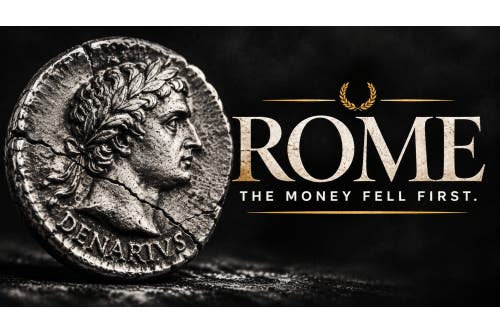
Rome’s troubles started long before it was even an empire. In 390 BC, the Celtic warlord Brennus sacked the city, now the capital of modern day Italy, and demanded a huge ransom in treasure to leave.
When the Romans complained that the scale Brennus used to weigh their treasure payment was unfairly balanced, he unsheathed his sword and threw it on top of the weighted side to unbalance it further.
“Vae victis,” Brennus told the Romans.
“Woe to the conquered.”
Rome survived… and went on to become an empire that itself conquered most of the known world before their eventual collapse.
No One Knows When Rome Fell: A Lesson For America
Ask any historian when the Roman Empire fell, and you’ll get wildly different answers.
Did the Roman Empire fall in 455, when the Vandals sacked the capital city for two weeks? Was it 476, when a Germanic general deposed the Western emperor, and didn’t even bother to replace him?
Or was it 1453, when Constantinople, capital of the Eastern Roman Empire, finally fell to the Ottomans… nearly a thousand years later?
Historian Edward Gibbon’s definitive history of Rome’s fall needed six giant volumes to tell the story. It covers more than 1,300 years.
No one agrees when Rome fell… and wise “Come and Take It” readers will notice what truth this history tells us.
Empires don’t collapse overnight. They rot slowly from the inside… and most of the everyday people living through the decline are slowly boiled like frogs in a pot of water.
The same is true of Roman money, the denarius.
The silver denarius was the U.S. dollar of the ancient world. Under Emperor Augustus at the beginning of the Roman Empire, the denarius was made of almost pure silver.
Like all great empires, soon the spending started.
Armies had to be paid. Bread and circuses had to be funded. Emperors had to buy the loyalty of the soldiers who kept them in power.
Rome didn’t have a printing press… so it did the next best thing. It quietly put less silver in each coin over the decades.
At first, nobody panicked. The coin still said “denarius.” It still bought bread. People had faith in the Roman Empire.
By the reign of Emperor Marcus Aurelius in the 170s AD, the denarius was roughly three-quarters silver. In 215, Emperor Caracalla introduced an entirely new coin, the antoninianus, valued at two denarii… but the coin contained nowhere near twice the silver.
50 years later, the antoninianus was a bronze coin with a thin silver wash. A coin that was once made of almost all real silver had become a token for the value of silver.
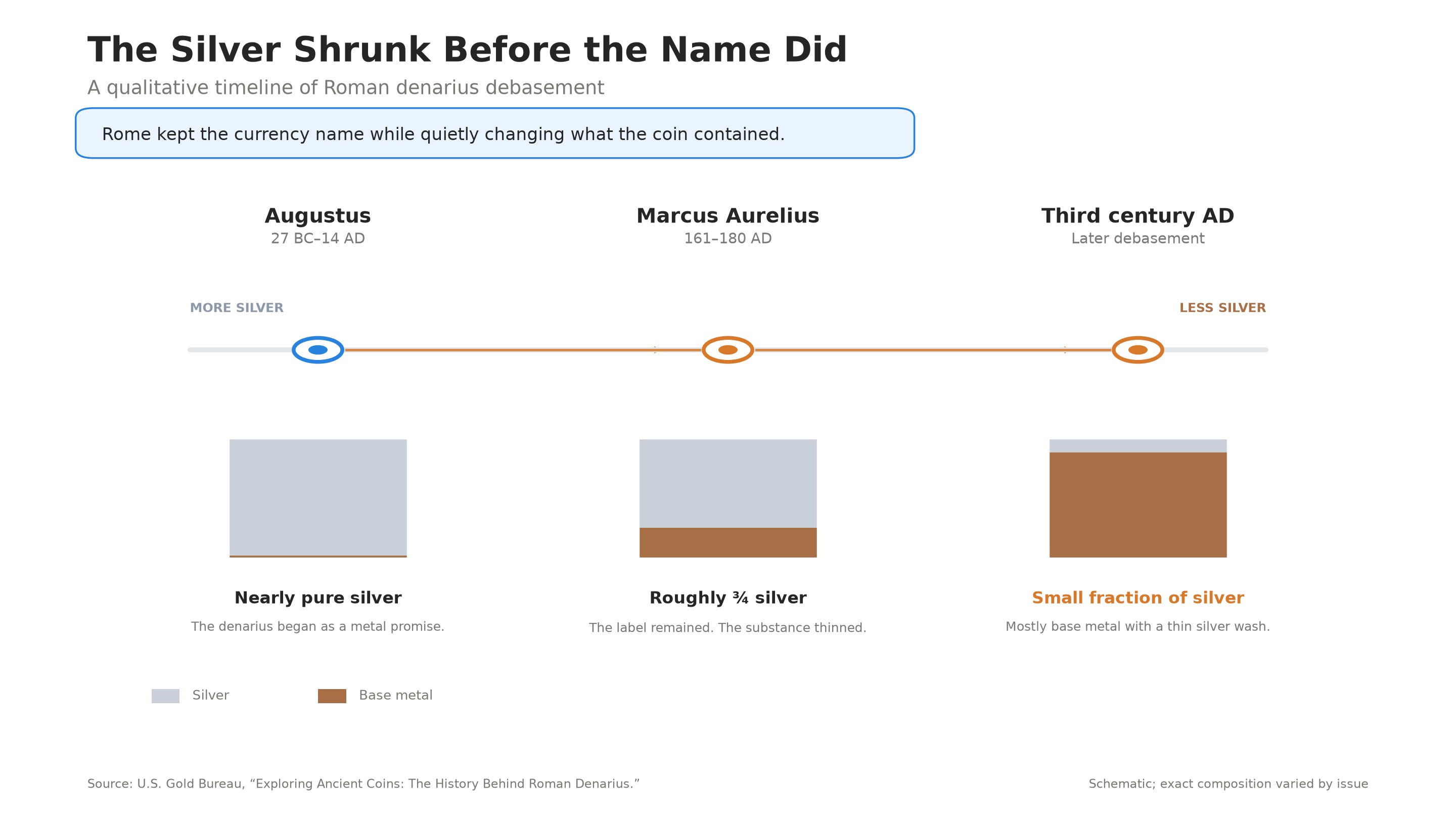
Chart 1. Roman denarius debasement: the name survived as silver content declined. U.S. Gold Bureau, “Exploring Ancient Coins: The History Behind Roman Denarius.”
Schematic; exact composition varied by coin issue.
Does this sound like a familiar tale?
Of course, the inflation came, just as it always does. In desperation, Emperor Diocletian in 301 AD tried to order “price fixes” — his famous Edict on Maximum Prices — for more than a thousand consumer goods.
It failed. Markets suddenly went barren, like a grocery store in the price-fixed USSR. The caps were eventually abandoned.
Governments that debase their money almost always reach for price controls next… and price controls have never once fixed the problem.
The Coin Was Solid. The Government's Promise Wasn't.
Here’s the part most people miss.
Roman money was made of valuable metal. That’s something the American dollar doesn’t have. Most of our currency isn’t even paper; it is held digitally. But even the Roman metal coins didn’t help savers who trusted the number stamped on them.
The Roman who saved 1,000 denarii in the year 100 and kept them in a jar got robbed. Not by the Barbarians or the Huns or bands of thieves.
He was robbed by his own government, one emperor at a time.
But the Roman who owned the silver itself? Or held valuable farm land? Or grain, livestock, olive groves?
His family was much more likely to be fed and healthy and safe throughout the long decline.
Even the Roman state figured this out. As its coins became worthless, the late empire increasingly wanted taxes paid in grains and goods, rather than their own coins.
While the West was declining and subject to increasingly large waves of foreign invasion, the Eastern Romans were using the gold solidus, a coin made of actual gold that weighed 1/72 of a Roman pound. And the solidus held its value in the Eastern Empire for roughly 700 years.
Why? Because anyone who held them knew that no matter what, the gold would hold its value.
They wouldn’t get rich holding onto Roman gold coins. But they wouldn’t go broke and starve, either.
The lesson to learn isn’t that metal coins might get you rich. They could, of course… but that’s not the real value.
The value is that tangible, physical assets protect you in a way that promises from a tax-and-spend addicted government don’t.
Devaluing Coins In A Digital World
Roman emperors began to slowly devalue Roman currency by melting down physical silver coins and mixing in cheap metal. It took a lot of time and effort.
Washington doesn’t have that problem, because the American dollar hasn’t been backed by gold since 1971 under President Richard Nixon.
Today, most dollars only exist in a database. The federal government can borrow, spend, and print new dollars with a keystroke… and it does.
The U.S. national debt crossed $40 trillion in August. Trillion. That’s 40,000 billion dollars, folks.
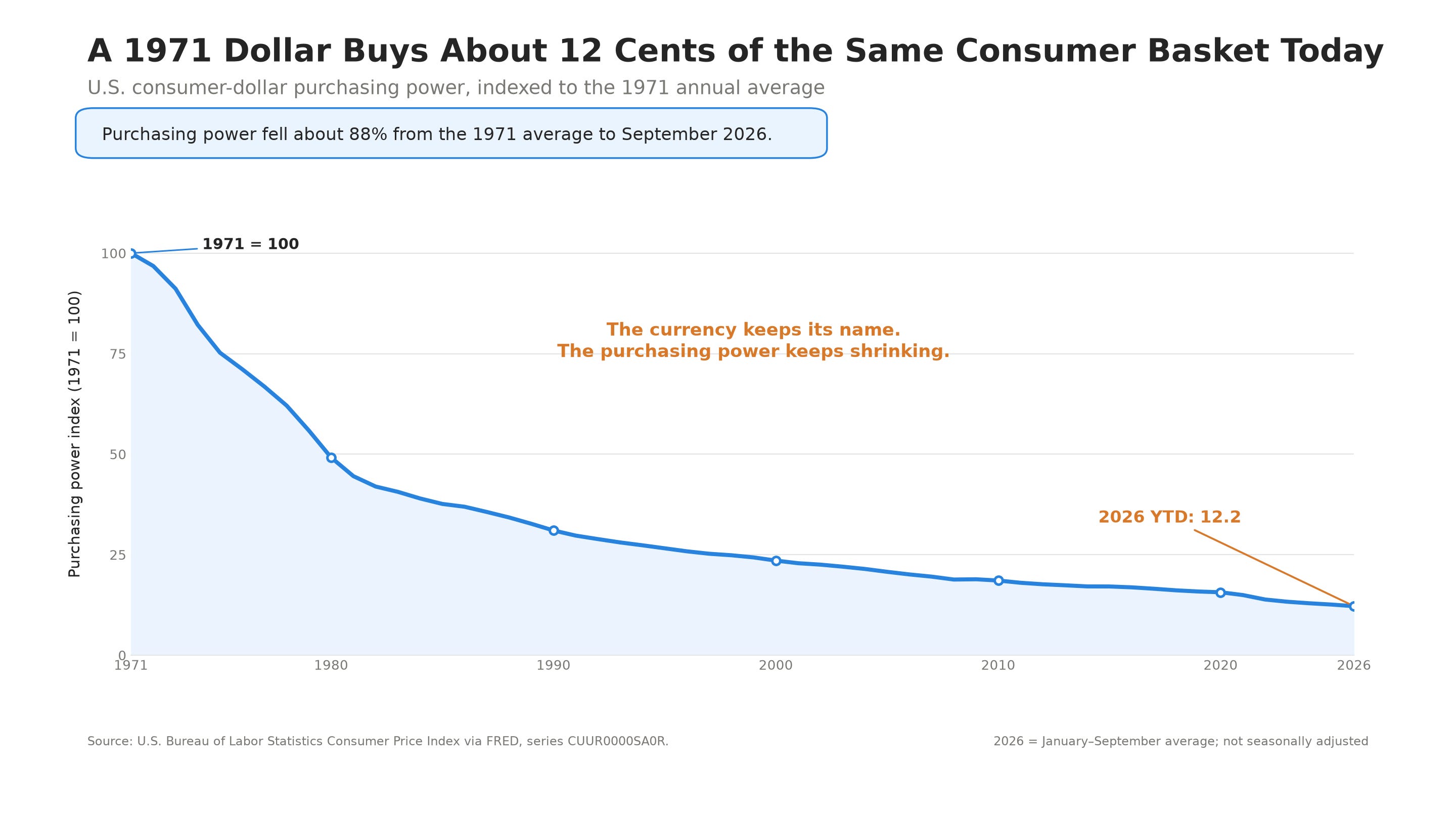
Chart 2. U.S. consumer-dollar purchasing power, 1971–2026. BLS Consumer Price Index via FRED, series CUUR0000SA0R.
2026 = January–September average; indexed to the 1971 annual average; not seasonally adjusted.
The government ran a $2 trillion deficit last fiscal year. Interest alone now costs about $1.1 trillion a year.
So, when does a currency start to lose its value as an empire is in decline… when it’s in a debt death spiral, and it is all digital?
Here’s the uncomfortable answer: it already has. A U.S. dollar today buys a fraction of what a dollar bought for your dad.
Your great-grandparents’ savings suffered the same fate of a Roman denarius.
Now, just think about what your dollar bought just 10 years ago, compared to today.
Washington, D.C. may not be physically sacked by an invasion of foreign hordes any time soon. But it doesn’t need to be for us to ask a simple question.
Does your denarius buy what it used to, my fellow Romans? My fellow Countrymen?
Posting in:
 byUnited States Gold Bureau