
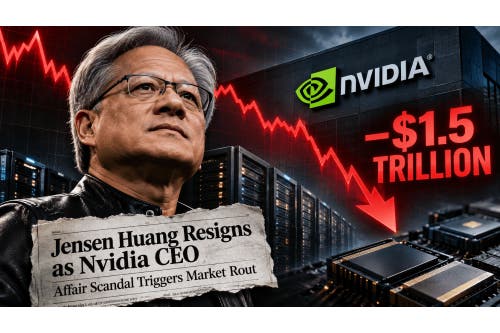
Jensen Huang's Affair Just Repriced the Whole Market. His Resignation Finished the Job.
After reports last week about Jensen Huang’s affair with an alleged Chinese spy, Nvidia’s stock fell nearly 25% from its early-October peak, erasing roughly $1 trillion in market value.
The New York Times report quoted Bernstein analysts saying demand “seems unlikely to be affected,” while the affair made “increased risks” to A.I. industry momentum plausible.
Then, earlier today when Huang resigned as president, CEO, and director, Nvidia shares opened down more than 13%, wiping out another half-trillion dollars.
BBC market coverage called the resignation “a stress test for the AI boom.”
The chips didn’t stop shipping. Nvidia’s customers didn’t disappear. The market simply revealed how much of the AI trade had been priced through the actions of just one man. Here’s a full breakdown and the possibly better trade behind it.
Nvidia's Filing Put a Face on the Succession Risk
Nvidia’s November 11 Form 8-K says the board accepted Huang’s resignation as president, chief executive officer, and director, effective immediately. The board appointed Chief Financial Officer Colette Kress as interim CEO while it searches for a permanent replacement. Kress will keep the CFO job. Harvey Jones became the board’s first chair.
The company’s transition announcement says Huang’s departure ends 33 years of leadership as co-founder. The board will consider internal and external candidates. The company also says customer commitments and the product roadmap should continue without interruption.
Reports about Huang’s personal conduct explain why the board met, but the filing explains what actually changed at the company.
The Market Priced the Founder, Not Just the Chips
The easy read says the scandal sits outside the business. Nvidia still has the customers, the products, the distribution, and the demand. That argument may be right operationally, but it fails as a full and complete picture of the stock post-Huang departure.
A market analysis reported that a personal revelation erased $1.5 trillion of value.
The New York Times report recorded that Nvidia had fallen nearly 25% from its early-October peak, even as the broader AI market rallied.
A board-meeting report documented the succession crisis and a more than 9% after-hours decline in the company’s stock price.
The market didn’t need a missed shipment to reprice Nvidia. It needed a governance shock. That doesn’t prove the chips are bad. It proves the market had bundled product demand with founder confidence.
Analysts called it “key man risk”. That is the phrase to keep in mind.
The retirement connection makes the point harder to ignore. Scott Galloway reported that the top 10 stocks in the S&P 500 made up roughly 40% of the index’s market capitalization, while AI-related stocks drove about 75% of S&P 500 returns since ChatGPT launched.
The Q2 retirement report counted $51.2 trillion in U.S. retirement assets at the end of June, including $10.8 trillion in 401(k) plans and $3.7 trillion in 401(k) equity funds.
You didn’t need to buy Jensen Huang’s company. Your retirement fund may have bought him for you.
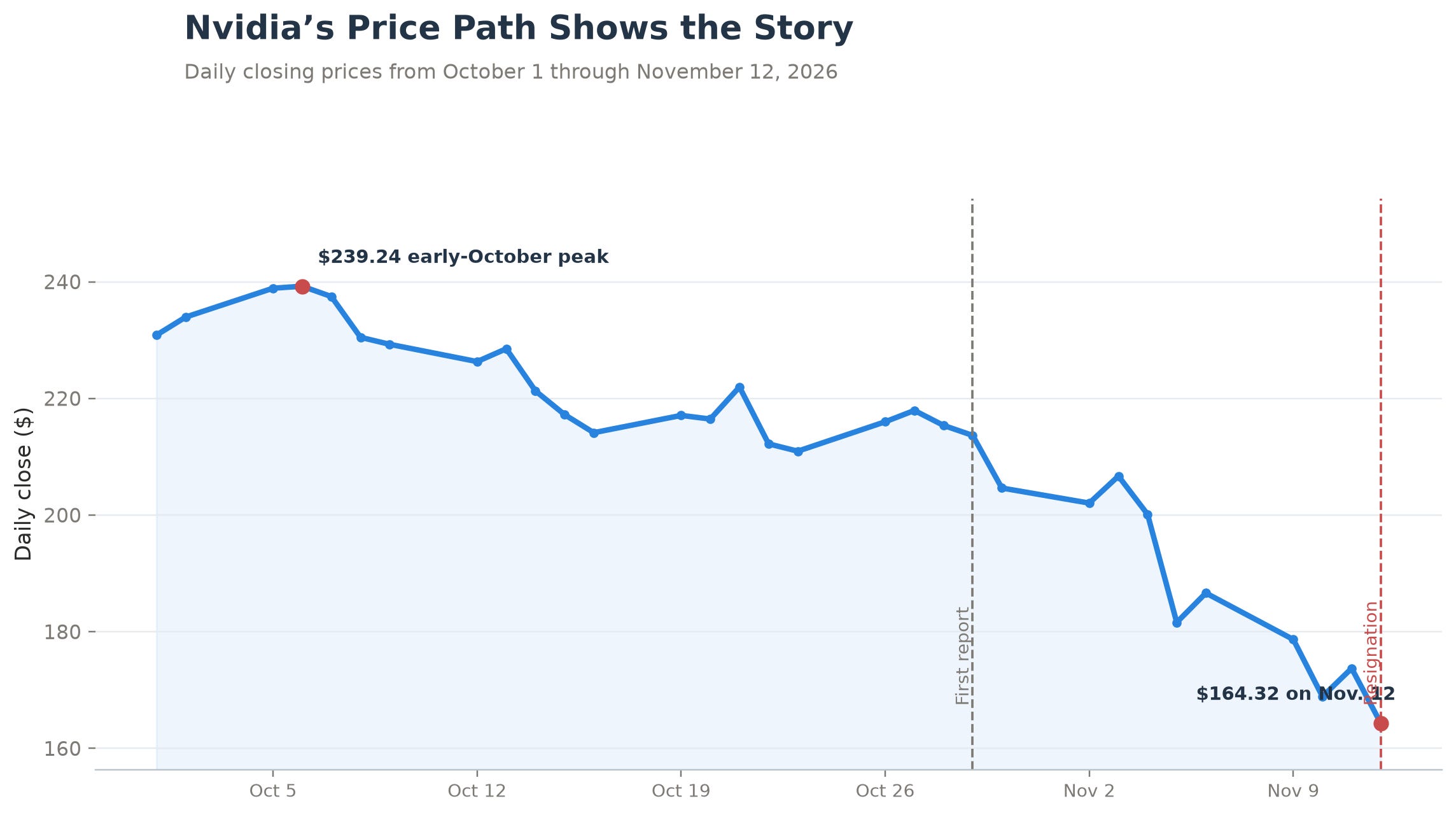
CHART 1 — NVIDIA DAILY CLOSES Nvidia’s daily closing-price path from October 1 through November 12, with reported event dates marked. Open source
The New CEO Won't Be Another Jensen Huang
Here’s the risk. Kress has been CFO since 2013. She comes from finance, not GPU architecture. The real question is whether she can lead the engineers who build Nvidia’s next jump in artificial intelligence. The company’s release says Kress has led finance and “played a key role in NVIDIA’s growth and evolution.” It describes her finance background and operating role, not an engineering or product-design record.
For anyone who owns an index fund, this isn’t celebrity gossip. It’s ownership risk. A founder-led company can make a person and a product look like one asset. When the founder leaves, you learn whether the moat sits in the chip, supply chain, customers, or storyteller.
Now the CEO must keep engineers, customers, and capital spending aligned. Demand has to belong to the platform, not just the face of it.
For most public companies, the CEO chair can become a revolving door and still hold value. At Nvidia, the CEO has been the narrator, salesman, strategist, and human proof of the AI story.
The market isn’t deciding whether chips work. It’s deciding how much of the premium belonged to the chips, and how much belonged to the orchestrator of the entire industry.
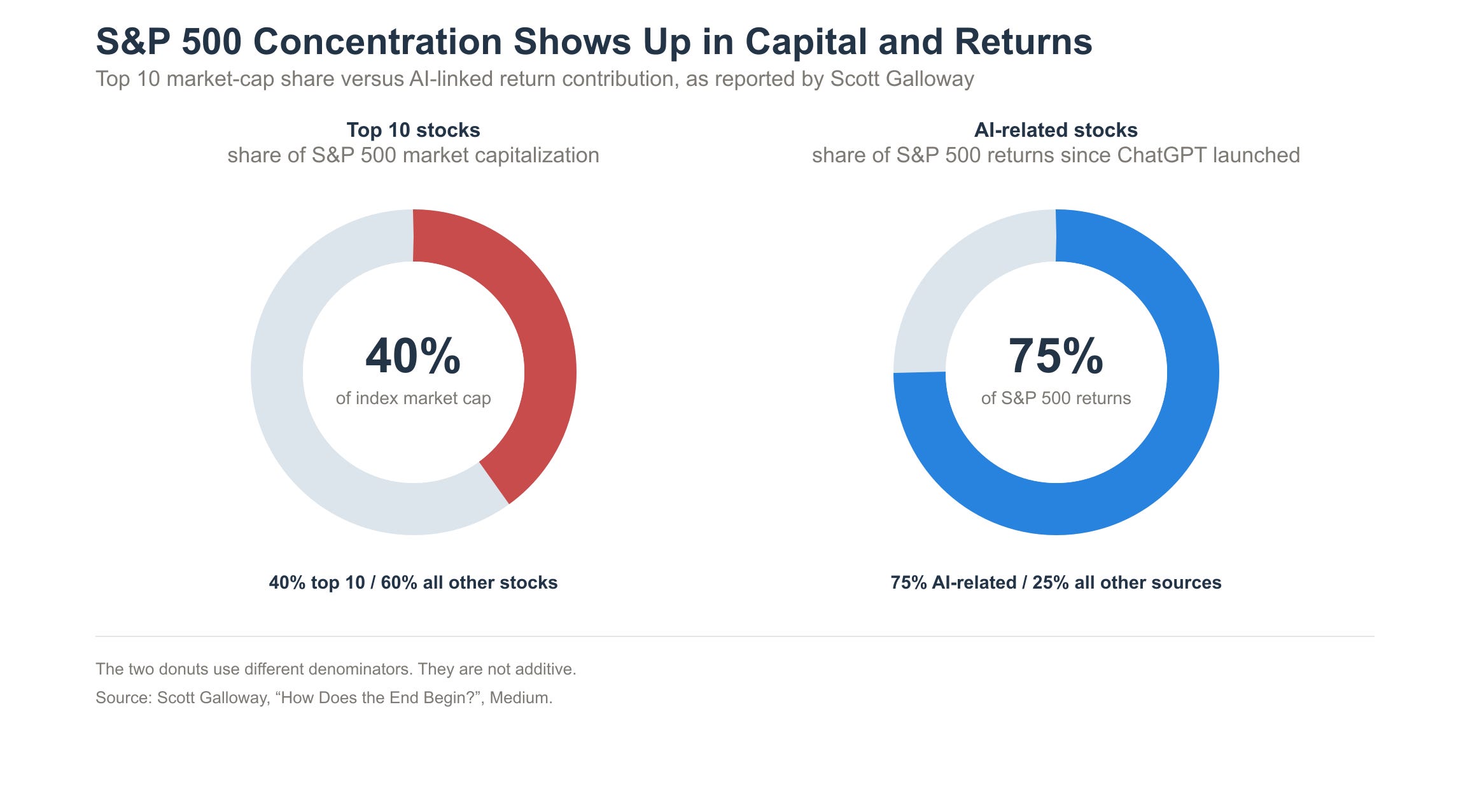
GRAPH 1 — S&P 500 CONCENTRATION BY CAPITAL AND RETURNS The top 10 S&P 500 stocks account for roughly 40% of index market capitalization; AI-related stocks drove about 75% of S&P 500 returns since ChatGPT launched. The two measures use different denominators. Open source
Own the Bottleneck, Not the Celebrity
That is the Shovel Trade. Don’t confuse a durable buildout with a durable multiple. Look beneath the AI headline to the physical bottlenecks: power generation, transformers, switchgear, data-center equipment, and suppliers with contracted backlogs.
The rule is simple. A backlog is a contract. A forecast is an opinion. Use company filings to separate the two. Avoid treating a market-cap-weighted AI fund as diversified simply because it owns hundreds of securities.
The point isn’t to throw out every AI holding. The point is to see where the concentration sits before it reaches your retirement account. Don’t invest in the same narrative that all AI companies are selling.
AI demand may outlive Jensen Huang, but if the circular nature of the AI trade is true, then the market just removed the cornerstone of the American economy. A durable buildout shouldn’t need one executive to carry its entire valuation.
Instead, own the equipment that makes the data centers run, and let the celebrity premium fall where it may. The shovel doesn’t have to give a keynote to get paid.
Posting in:
 byUnited States Gold Bureau