

Gold’s latest slide has pushed the rebound question aside. The immediate test is whether buyers can stop a string of fresh lows.
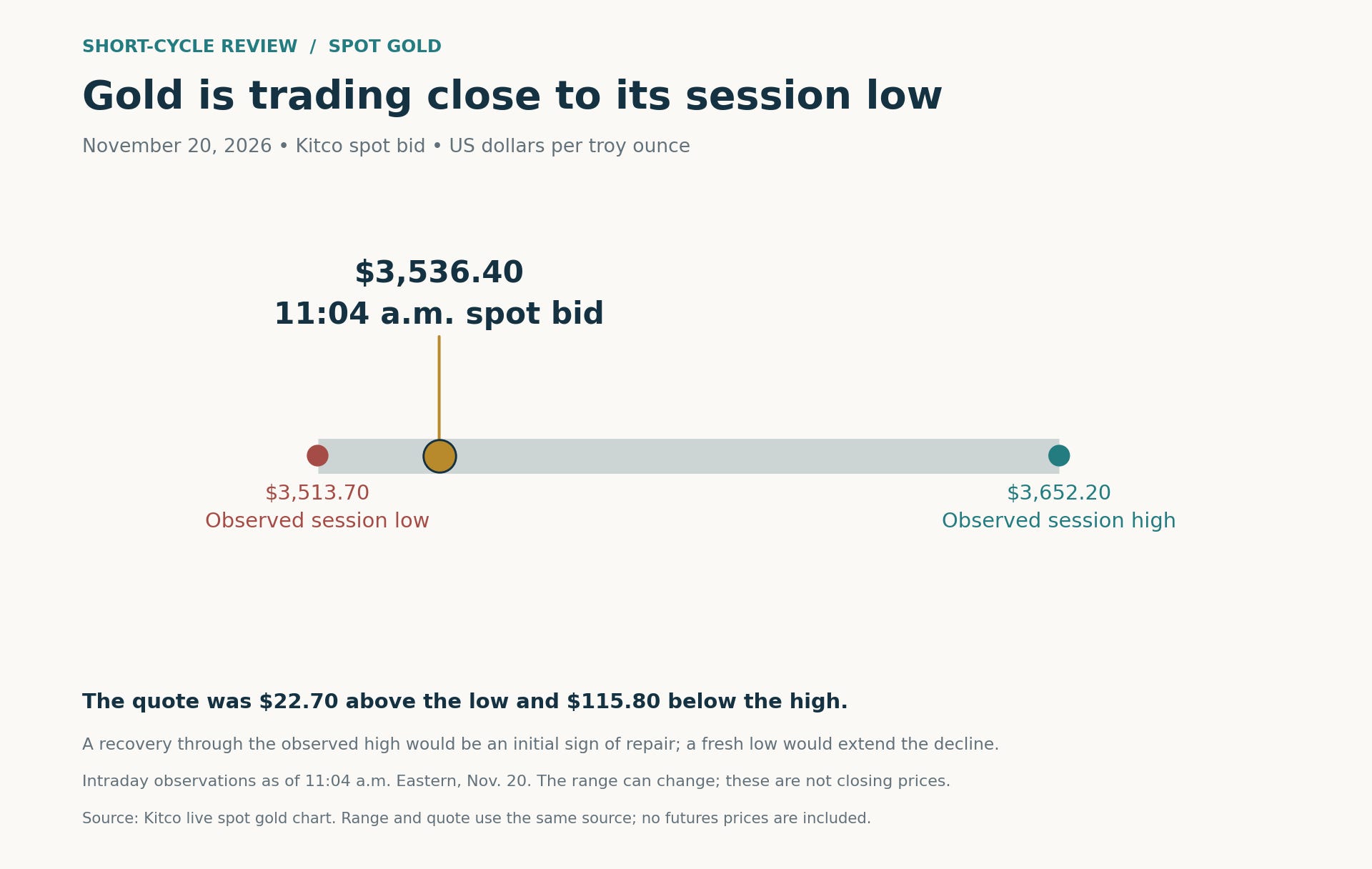
At 11:04 a.m. Eastern on Nov, 20, Kitco’s spot bid was $3,536.40 an ounce. Its quoted session range ran from $3,513.70 to $3,652.20. Gold was trading much closer to the low than the high.
That leaves an accelerating decline as the working pattern. A brief bounce would offer relief, but buyers need to reclaim lost ground and hold it before calling the move a recovery.
Selling Has More Than One Source
The pressure extends beyond expectations for higher interest rates. Reuters reported Friday that losses in AI-linked shares were prompting some investors to liquidate gold positions to cover losses elsewhere.
David Meger of High Ridge Futures identified that cash-raising pressure alongside the strong dollar and hawkish rate outlook.
This helps explain why gold can fall during an equity selloff. An asset held for protection can also be sold because it offers ready access to cash.
Earlier speculation that investors were freeing money for Anthropic’s IPO remains a possible contributor. It has not established how much gold selling funded the offering. The broader liquidation explanation deserves more weight than a single-event story.
The Levels That Would Show Repair
Friday’s observed low near $3,514 gives investors a concrete reference. A fresh break below it would extend the decline and invalidate an early stabilization attempt.
Holding above that low would be a start. The stronger evidence would be a recovery through the session high near $3,652, followed by a pullback that holds above the earlier low.
Those are observed trading levels, not a forecast that either will hold. The sequence matters: stop making lower lows, recover ground, then retain some of the gain when sellers return.
Until that happens, a sharp upward move can still be a pause within the downtrend.
What Buyers Can Do With the Signal
Investors building a long-term holding can use these checkpoints to pace purchases. Buying in stages leaves room to respond if the decline continues rather than committing everything to the first bounce.
A softer dollar and easing rate expectations would help. So would signs that selling linked to losses elsewhere is fading.
Gold’s longer-term appeal does not require a perfect entry. But the short-cycle evidence should improve before investors treat a lower price as proof that the selling is finished.
Posting in:
 byUnited States Gold Bureau