
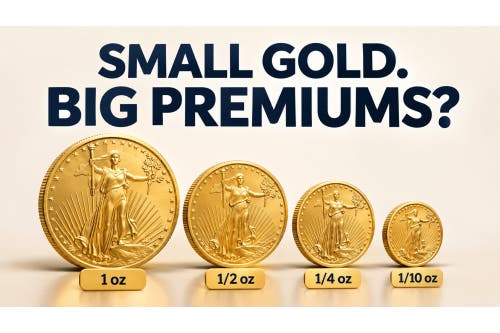
Investors often gravitate toward silver because it feels accessible. A one-ounce Silver Eagle might cost less than $100, while a one-ounce gold coin can cost thousands of dollars. That price gap is exactly why fractional gold exists.
Fractional gold allows investors to buy smaller amounts of physical gold instead of committing to a full ounce. You can purchase coins, bars, or rounds weighing a half-ounce, quarter-ounce, tenth-ounce, or even just a gram. For investors who want exposure to gold without spending thousands of dollars at once, that sounds like an attractive solution.
The catch is the premium. For example, if a coin contains $450 worth of gold but costs $500, that extra $50 is the premium.
On a one-ounce coin, the premium is usually modest. On very small pieces of gold, however, the premium can become surprisingly large.
Understanding those premiums is key to making informed fractional gold purchases.
Understanding Fractional Gold
Fractional gold refers to any physical gold product weighing less than one troy ounce.
The most common category is fractional government-issued coins. These include products such as the American Gold Eagle, Canadian Maple Leaf, South African Krugerrand, and Austrian Philharmonic. Typical sizes include 1/2 oz, 1/4 oz, and 1/10 oz coins. While some carry nominal face values, investors buy them for their gold content, not their spending power.
A second category includes fractional bars, usually measured in grams. Common sizes are 1 gram, 2.5 grams, 5 grams, and 10 grams. Reputable refiners produce many of these bars, and most arrive sealed in assay packaging, which helps verify authenticity and makes resale easier.
Beyond those products are ultra-small gold items, including micro coins, novelty pieces, gold notes, and products like Goldbacks. These often contain tiny amounts of gold measured in milligrams rather than ounces or grams. While they contain genuine gold, buyers should pay close attention to the premium relative to the amount of gold they contain.
Melt Value: What the Gold Is Actually Worth
At its core, every gold product has a melt value:
Melt Value = Gold Weight × Current Gold Price
This figure represents the value of the gold itself.
For example, if gold traded at $4,500 per ounce, a 1/10-ounce coin would have a melt value of about $450. A one-gram bar would have a melt value of roughly $145. A tiny gold note containing only a few milligrams of gold might have a melt value of just a few dollars.
How Fractional Gold Sizes Compare
|
Product |
Gold Content Relative to a 1 oz Coin |
|
1 oz coin |
100% |
|
1/2 oz coin |
50% |
|
1/4 oz coin |
25% |
|
1/10 oz coin |
10% |
The melt value acts as a baseline. Everything you pay above that amount is the premium.
Many investors are surprised when they realize how little gold some micro-fraction products actually contain. A novelty piece selling for $20, $30, or even $50 may contain only a few dollars' worth of gold.
Why Premiums Rise as Gold Gets Smaller
Large premiums often come down to simple math.
Whether a product contains $4 worth of gold or $4,000 worth, it still needs to be manufactured, packaged, stored, shipped, marketed, and sold. Many of those costs are nearly identical regardless of size.
A one-ounce Gold Eagle spreads those costs over several thousand dollars' worth of gold. A one-gram bar spreads those same costs across roughly $145 worth of gold.
That is why larger bars often carry lower premiums, while smaller fractional products generally carry higher premiums.
Match the Purchase to the Goal
The best way to evaluate a fractional gold purchase is not by its price tag alone, but by understanding how much of that price goes toward the gold itself.
Two products might each cost $50, but they can serve very different purposes. One buyer may be focused on acquiring as much gold as possible for their money. Another may value a collectible design, a unique theme, a gift item, or the convenience of a smaller denomination.
There is nothing inherently wrong with buying fractional gold, collectible pieces, or products with higher premiums. The important thing is understanding what you're paying for and making sure it aligns with your goals.
If your primary objective is accumulating gold, comparing the purchase price to the melt value can help you determine how much of your money is going toward the metal itself. If your goal is collectability, portability, gift-giving, or simply owning a product you enjoy, the premium may matter less.
In the end, the best purchase is the one that matches your objectives and comes with a clear understanding of both its gold content and its cost.
Posting in:
 byUnited States Gold Bureau