
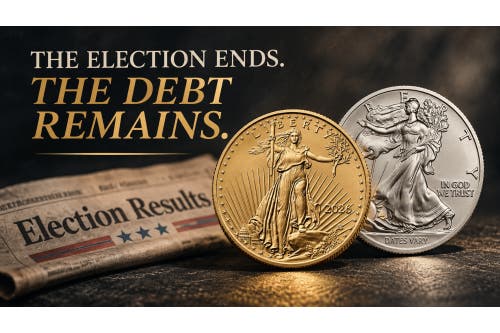
In the days following this week's elections, investors will ask countless versions of the same question: What does it mean?
What does it mean for stocks, bonds, housing, inflation, gold, and silver?
For precious metals investors, the answer may matter less than many people think.
While elections can influence markets in the short term, the long-term outlook for gold and silver will be driven by forces that extend far beyond a single election cycle. Regardless of who won or lost this week, the underlying trends that have supported precious metals for years remain firmly in place.
Those trends include rising government debt, persistent deficits, currency debasement, central bank demand, and geopolitical uncertainty.
Government Debt: A Long-Term Tailwind
Washington's debt problem continues to grow regardless of which party is in power.
Total U.S. debt now exceeds $40 trillion[1], while publicly held debt has climbed above the size of the nation's annual economic output for the first time since the aftermath of World War II[2].
However, this isn’t solely an American problem. Governments around the world continue to accumulate debt at unprecedented rates. Historically, higher debt burdens increase concerns about financial stability, currency strength, and future inflation. Those conditions have often strengthened gold's appeal as a store of value.
Bottom Line: Debt is growing faster than the economy, and that remains a bullish backdrop for precious metals.
Deficits, Currency Debasement, and Inflation
Debt does not emerge in a vacuum. It is the result of deficits.
Year after year, Washington spends more than it collects, financing the difference through borrowing. As deficits accumulate, debt grows larger. Eventually, governments face pressure to either raise taxes, reduce spending, or allow inflation and monetary expansion to ease the burden.
That process creates a chain reaction:
Deficits → Debt → Monetary Expansion → Currency Debasement → Inflation
Since the United States left the gold standard in 1971[3], the purchasing power of the dollar has steadily declined. Goods and services that once cost a fraction of today's prices now require substantially more dollars to purchase. Over the same period, gold has dramatically outperformed cash as a long-term store of value.
This relationship explains why investors often turn to gold during periods when confidence in fiat currencies begins to weaken.
Bottom Line: The long-term erosion of purchasing power remains one of the strongest arguments for owning gold.
Central Banks Continue Buying
One of the most overlooked developments in the gold market is the behavior of central banks.
While many investors remain underexposed to precious metals, some of the world's largest financial institutions continue adding to their gold reserves. Recent buying by countries including China, Poland, Kazakhstan, and Uzbekistan reflects a broader effort to diversify away from exclusive reliance on dollar-based reserves.
When central banks increase their gold holdings, they create a powerful source of long-term demand that is largely independent of short-term market sentiment.
Bottom Line: When the institutions that manage national reserves are accumulating gold, individual investors should pay attention.
Geopolitical Uncertainty Remains Elevated
Gold has long benefited during periods of uncertainty.
Geopolitical tensions, military conflicts, trade disputes, and political instability tend to increase demand for assets perceived as safe havens. Today's environment contains no shortage of potential catalysts.
At the same time, rapid technological change is creating both opportunity and disruption. Throughout history, periods of major innovation have often been accompanied by economic uncertainty, market volatility, and shifting political dynamics.
Whether the source of uncertainty is international conflict or domestic political division, investors frequently seek the stability that precious metals can provide.
Bottom Line: When uncertainty rises, gold's role as financial insurance becomes increasingly valuable.
What Really Matters for Gold and Silver
The election will dominate headlines for weeks. Markets will react, predictions will be made, and investors will attempt to position themselves for the next policy shift.
Most of that noise is temporary.
The trends that matter most to precious metals investors are not measured in weeks or months but in years. Rising debt, persistent deficits, currency debasement, central bank buying, and geopolitical uncertainty are all long-duration forces that are unlikely to disappear because of a single election result.
Those are the catalysts that can drive gold and silver prices higher over the next decade. The smart money isn't focused solely on who won this week's election. It's focused on the structural realities that will remain long after the election headlines fade.
Posting in:
 byUnited States Gold Bureau